Most Abundant Butterflies: Bear Creek Canyon

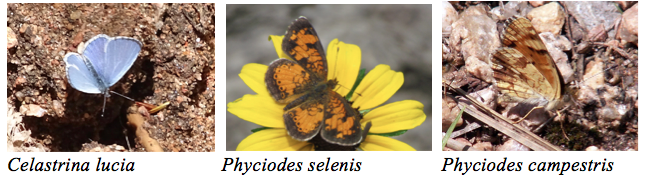
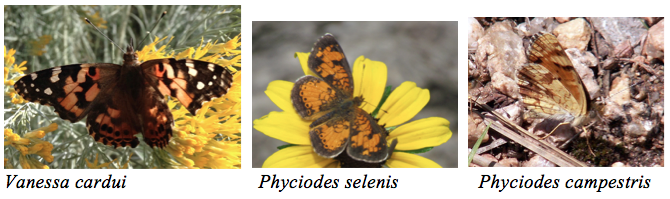
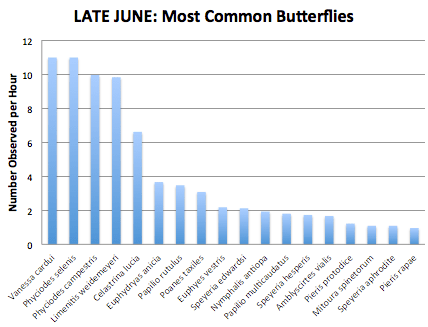
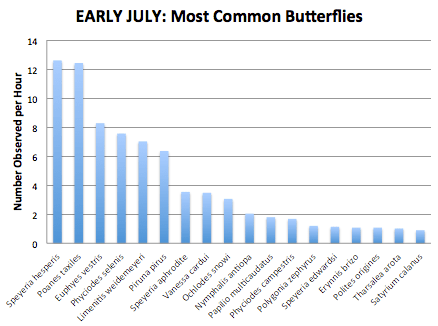
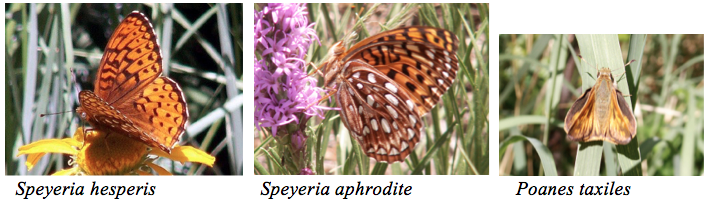
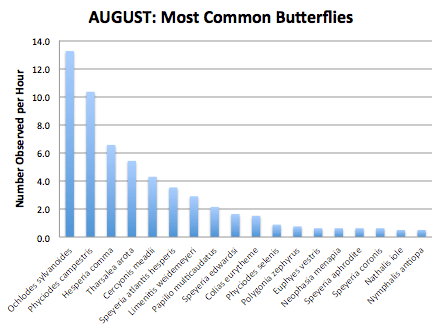
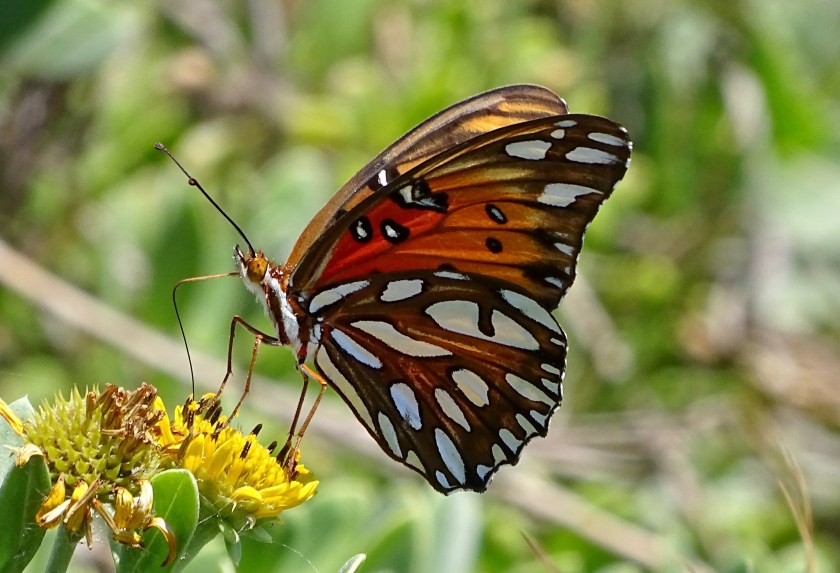
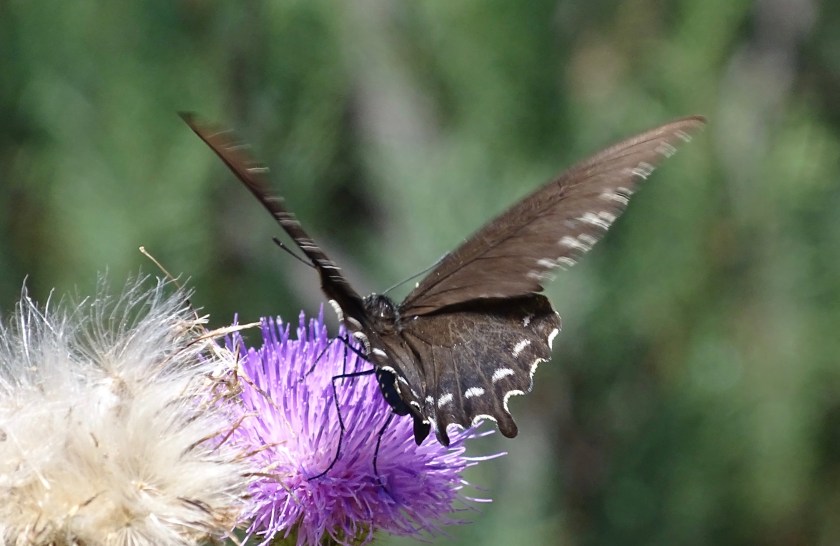
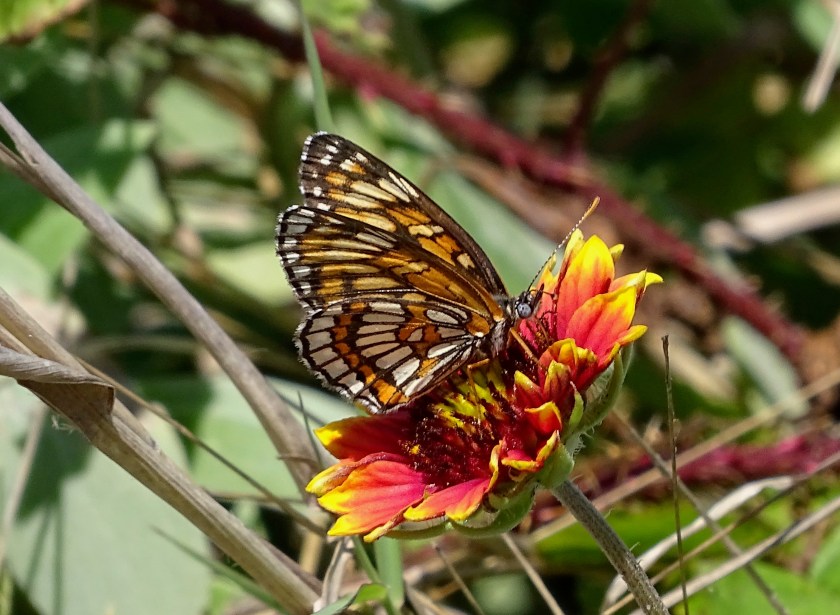
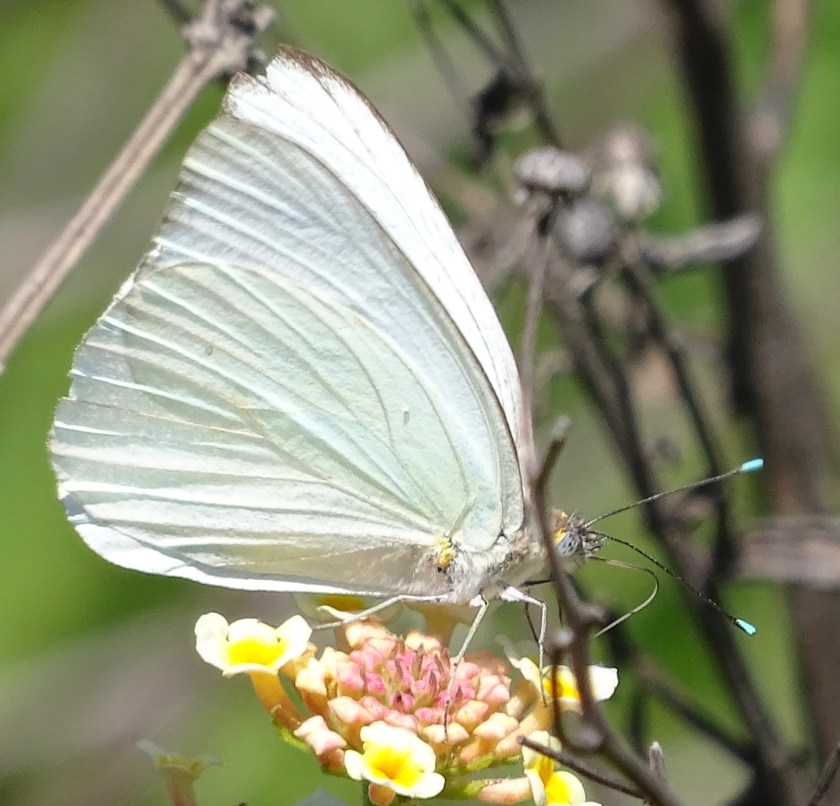
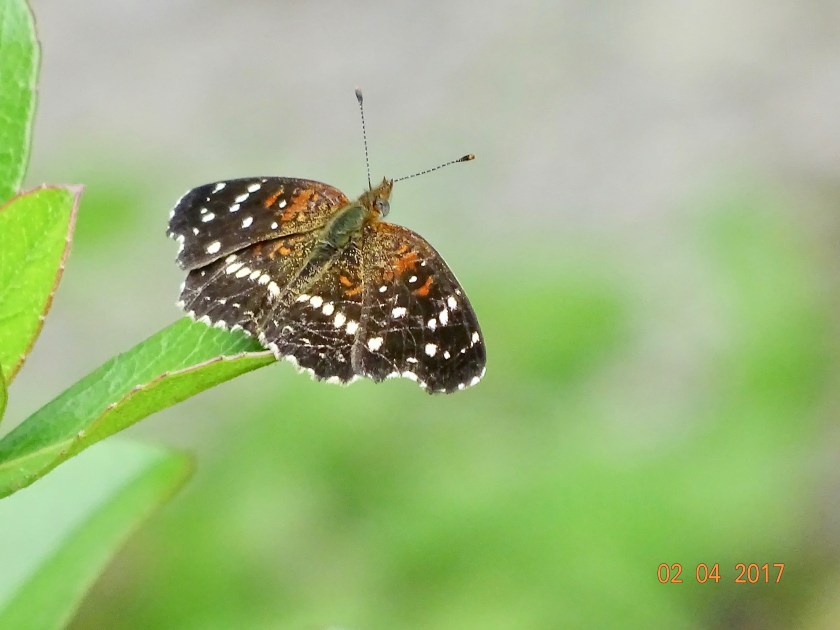
Here are graphs showing the 18 most abundant species of butterflies in each summer month or half-month. These are based on 23 years of observations of tens of thousands of butterflies. The y-axis shows the numbers of butterflies noted per hour of observation time. This is a historic record, and I understand that many readers will not know the scientific names of these butterflies, but I am illustrating the three most common above each graph. Nymphalis antiopa, the mourning cloak, hibernates as an adult and flies on the warmest days in February. Celastrina lucia is the tiny spring blue that sometimes congregates at mud spots. Its taxonomy is still uncertain. It is the most common butterfly in the canyon from April through early June. In July, its numbers fall off and it is replaced by a series of brush-footed butterflies that are of medium size and generally orange and black in color. Limenitis weidemeyeri is a large black butterfly with bold white bands across the wings. In July, the silver spots (Speyeria) and a couple of skippers (Poanes and Euphyes) become common.Screen Shot 2017-05-23 at 10.51.50 PM
April

This amounts to about 26 butterflies per hour.

– – – – – – – – – – – – – – – – – – – – – – –

Screen Shot 2017-05-23 at 10.58.40 PM

Early May

This amounts to about 43 butterflies per hour.

– – – – – – – – – – – – – – – – – – – – – – –

Screen Shot 2017-05-23 at 11.07.28 PM

Late May

This amounts to about 60 butterflies per hour, but over half of them are the little Spring Azure Blue.

– – – – – – – – – – – – – – – – – – – – – – –

Screen Shot 2017-05-23 at 11.15.05 PM

Early June

This amounts to about 58 butterflies per hour.

– – – – – – – – – – – – – – – – – – – – – – –

Screen Shot 2017-05-23 at 11.18.44 PM

Late June.png

Now we’re at about 72 butterflies per hour. Quite a jump from June.

– – – – – – – – – – – – – – – – – – – – – – –

Screen Shot 2017-05-23 at 11.26.50 PM

Early July.png

And all the way up to 76 per hour…

– – – – – – – – – – – – – – – – – – – – – – –

Screen Shot 2017-05-23 at 11.31.44 PM

Late July

Then, rather suddenly, back to about 44 butterflies per hour. Clearly, July is butterfly month in the Colorado foothills.

– – – – – – – – – – – – – – – – – – – – – – –

Screen Shot 2017-05-23 at 11.39.04 PM

August

Or about 55 butterflies per hour.

By September, numbers drop to about 20 butterflies per hour in random habitats. But from late September through October and into November, butterflies can be found in large numbers on rabbitbush, Chrysothamnus nauseosus. On these bushes, I have found 145 butterflies and over 200 day-flying moths in less than a half hour. That’s an average of about 290 butterflies per hour!

More early emergence records

This spring continues to be the warmest I’ve seen, with new early emergence records rolling in each week. Today in Bear Creek I found Erynnis telemachus, the Rocky Mountain duskywing, usually not seen until the second week of April, and Celastrina lucia, the spring azure blue, which usually starts flight around April 5th. Pussy willows in full bloom draw in large numbers of butterflies if you stop and look closely. All of the following are early records in 2017.

Erynnis telemachus, a surprise, especially because another species, E. brizo, usually flies first, and it hasn’t been seen yet.

DSC02480

Celastrina lucia, the spring azure blue.DSC02487

Pieris rapae, the European cabbage butterfly, an import– in some parts of North America, the most abundant butterfly.DSC02468

Nymphalis milberti, Milbert’s tortoise shellDSC02475

Archiearis infans, the Infant moth, photographed in the net and released.DSC02472


Unconformity on Shelf Road

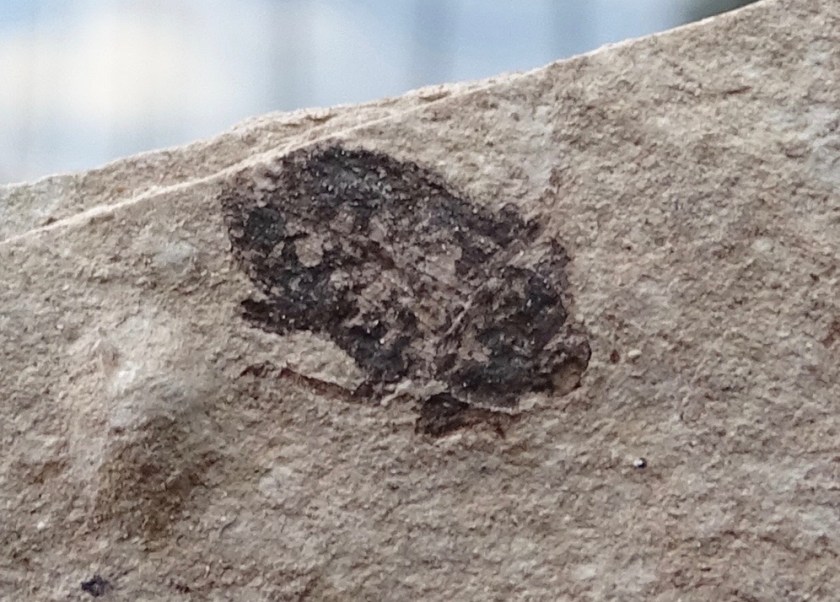
Precambrian granite (about 1.6 billion years old), distinct to the practiced eye from Pikes Peak Granite, sits directly under the Ordovician Manitou Limestone (~ 450 million years ago), which has fossilized scales from jawless fishes. This contact represents over a billion years that’s missing from the geologic record (at this site). That means that the old granite probably had a series of overburdens that may have represented many events, but the evidence has all eroded away, leaving the nearly flat erosional surface, upon which the seafloor sediments accumulated that became the limestone. On Shelf Road you can put your finger on over a billion years of missing time.screen-shot-2017-03-04-at-10-18-49-pm.png

dsc02418.jpg


Early and Late Records for El Paso County Butterflies

Here is a list of my personal records for the early and late observations of about 170 butterfly species in El Paso County. I hope that other naturalists will make notes and contact me with new records. Collected specimens are the best way to verify sightings, but photographs usually work.

screen-shot-2017-02-18-at-1-11-31-pmscreen-shot-2017-02-18-at-1-11-55-pmscreen-shot-2017-02-18-at-1-12-12-pmscreen-shot-2017-02-18-at-1-12-33-pmscreen-shot-2017-02-18-at-1-13-01-pm

Butterfly abundance indices, Bear Creek Canyon, El Paso Co., Colorado

Amblyscirtes eos

Introduction and site description:     Butterfly surveys have been used around the world for several decades to determine the ecological health of habitats and to document or measure changes over time. In El Paso County, since F. Martin Brown began his first forays into the hills to document butterfly ranges in the 1930’s, the human population has grown from about 33,000 to over 587,000. In the same time interval, the land area of Colorado Springs proper has increased from about 12 square miles to nearly 300 square miles, and the current human population density of Colorado Springs is about 2027/square mile, and that of El Paso County about 276/sq. mi. (http://www.citydata.com/county/El_Paso_ County-CO.html; U. S. Census Bureau 2000 Report). Although the habitat loss concomitant with development caused many local population extinctions, especially as wetlands were disturbed, the city of Colorado Springs today is bordered by abundant preserved public lands, and it is probable that most butterfly populations in the areas around the city are little changed in the wake of this extensive development. Strongly restricted species, however, may now have fewer refugia and may occur in depressed populations. Regional extinctions may have gone undetected. Continue reading “Butterfly abundance indices, Bear Creek Canyon, El Paso Co., Colorado”

Earliest Spring Butterflies

Obviously, it’s not spring yet, but with the last few warm days, the butterfly species that hibernate as adults (most butterflies hibernate as pupae, larvae or even eggs) are feeling springtime in the air. Today in Bear Creek I found two species, the earliest date ever for the anglewing, and the second earliest date for the mourning cloak (Eric Eaton saw a mourning cloak in town on the 6th!). These species emerge from the pupa in August, September, October or even November, and then find safe refuge in deep grass clumps or under bark until spring. But 75°F feels a lot like spring to us, and to butterflies as well. the top is the mourning cloak (Nymphalis antiopa) and the bottom the zephyr anglewing (Polygonia zephyrus).

DSC02379.jpgDSC02388.jpg

Historic Star Ranch

I grew up at Star Ranch, a Young Life summer camp dedicated to saving teenagers’ souls. The Ranch, previously a tuberculosis sanitarium, functioned as an evangelical camp from 1949 until the mid 1970’s, when it was sold to International Students, Inc., which served a similar purpose except directed at foreign exchange students who were far from home and vulnerable. The property fell into decline, was divided into two halves, and finally bought by Nichols and Comito for a gated community development that they called “Historic Star Ranch.” Here are a few photos of the Ranch, before and after.

First, the “house” in which I grew up. The downstairs is the Dining Hall, which fed about 150 people every meal. For several years, we lived in the upstairs, but only the right half. Later, we got the whole upper story. And, below, after Nichols and Comito prepared the grounds for Historic Star Ranch.

Star Ranch

dsc_0011

“The Lodge,” as we knew it, had two huge rooms, one a recreation room for ping pong and pool, and the other a “library” for meetings. Then and now. In the bottom photo, the Lodge footprint is in the middle ground, right. The rock pile on the left is the rubble, awaiting the bulldozer.anzgx

dsc_0010

The only historic aspect of this is the destruction of every detail that characterized Star Ranch. The only detail they were unable to destroy was this tiny grave, protected by State law, with a flat headstone that seems to read, “Daughter of G. and Ida Louma / Adopted dau. of S. & Phebe Briggs. / Died / Oct. 1, 1872 / Aged 7 Years / She being dead, yet spiritual.”DSC_0007.jpg

This old shed stood next to the head stone, and they had trouble destroying it without disturbing the grave site.DSC_0002.jpg

When Nichols and Comito finished bulldozing every structure on the Ranch grounds, except this stone shed, they invited my sister and me to come up to reminisce about our lives at the Ranch. They showed us the rubble fields where the main buildings once stood. They asked about our lives there. It was the single most insensitive act I’ve experienced, to ask people to identify the ruins of their home. “So, where exactly was your home?”